
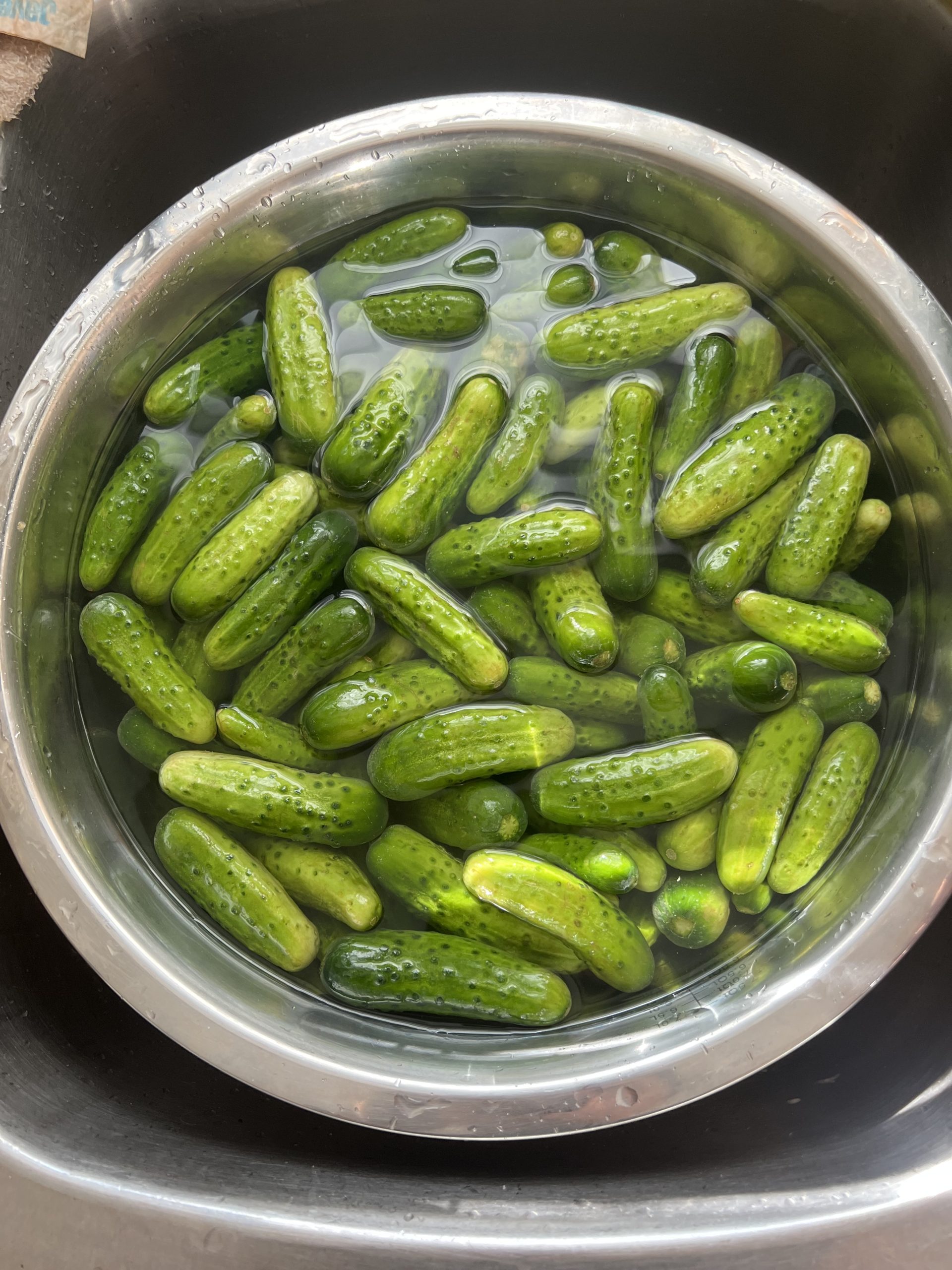
For many years in Canada I haven’t had storage space to pickle vegetables, nor did I really have time. However, in the last few years as we moved to the house and I became a bit more intentional about how I allocate my time, I wanted to start canning and pickling again, just for fun.
Part of me is longing for home. I sometimes really miss those blessed times in my childhood when mom and dad were excited about managing their harvest. They were always so proud to announce how many jars they made this year! Those were moments when they were too busy cooking they were forgetting their troubles. The jars then were used as gifts when we were invited for dinners.
For me, pickling vegetables is not about preserving or trying to save money on summer discounted veggies (although I found decent deals if buying in bulk on St Jacobs Market in Waterloo, ON area). It is a time travel to our kitchen back home in Ukraine, to the heat of August in 1990s, when it transformed into a canning manufacture. Mom and dad are helping each other, TV is blasting, and multiple jars are lining in our living room as a proud display of their achievement this year at the cottage.
Pickling is also about getting that flavour that only my household had. As we all know each cook has their own twist on recipes, each region of the country will have a different flavouring. These pickles are my favourite. They are super simple and crunchy.
I recovered the recipe from my sister’s cookbook, which she copied from our mom’s book which is now lost.
So I am sharing with you a very special recipe for me. I only made a few jars this year and can’t wait to celebrate them with my family in a few months.

Ingredients:
Pickles (I got small ones from the market) – to fill your jars
Dill with flowers and seeds – at least one per jar
Garlic cloves – one or two per jar
Vinegar – 2 tbsp per 1 L of the brine solution
Salt – 1 tbsp per 1 L of the brine
Hot pepper – one or two small ones on the bottom of each jar
Bay leaves – 1 per jar
Black peppercorn
First, wash your pickles well and cut the tips from both ends a little bit. Some people also soak them for a few hours in water with salt which I did on part of the batch.
Sterilise your jars and lids in the dishwasher (or the old fashioned way on the water bath). I reuse jars from the store bought sauces as I find them more convenient then the two piece lids used in Canada.
Pack your jars with the pickles, but first place dill, a few black peppercorns, a bay leaf and garlic cloves on the bottom. Some people add mustard seeds, currant or cherry leaves too.

Boil the water in a kettle and fill the packed jars with boiling water. Let it sit for 5 mins.
Collect the brine into a measuring cup from a few jars. I have a 2L measuring cup and will usually collect 1-2 litres from a few jars. Then calculate the amount of salt you need, add it and boil for about 5 mins.
Refill the jars with the boiled solution and add 2 tbsp vinegar for a large jar of 2 L or 1 tbsp for 1L jar (we use 9% vinegar in Ukraine, so I got a bottle of it from European store or sometimes just recalculate the amount I need from the 70% concentrate or 5% one – but I have a chemistry background so you may want to just look up the calculations based on what vinegar concentration you have). You might need to add a few drops of boiling water to fill the jars to the top.
Screw on the lids tightly and place the jars upside down in a warm place. We used to place them on newspapers and cover them with blankets for slow cooling. These days it is debated that with the modern lids you don’t really need to do that but I still do just out of tradition.
Let me know if your family has a canning tradition and if you have any tips or tricks on this recipe in the comments – I would be very curious to try out new options.